

Key Takeaways
- Choosing the right double side rotary tablet press machine involves evaluating production output and tablet specifications.
- A variety of tooling types is crucial for selecting the right double side rotary tablet press machine manufacturer in India.
- Consider tablet diameter and compression pressure when deciding which rotary tablet press is suitable for your needs.
- Lodha offers multiple configurations, including the LI-DT 37, 45, 55, and 61, each designed for specific production capabilities.
- Understanding the key factors like production output and tablet size is crucial for selecting the right double side rotary tablet press.
Selecting a tablet press is not only about choosing the machine with the highest output. Station count, tooling type, tablet diameter, compression pressure and formulation requirements all influence which configuration is suitable for a production line.
At Lodha International LLP, we manufacture double side rotary tablet press machines in multiple configurations for pharmaceutical and related tablet-production applications. As a Double Side Rotary Tablet Press Machine Manufacturer in India, we configure each machine according to the required tablet specifications and desired production capacity.
What Is a Double Side Rotary Tablet Press Machine?
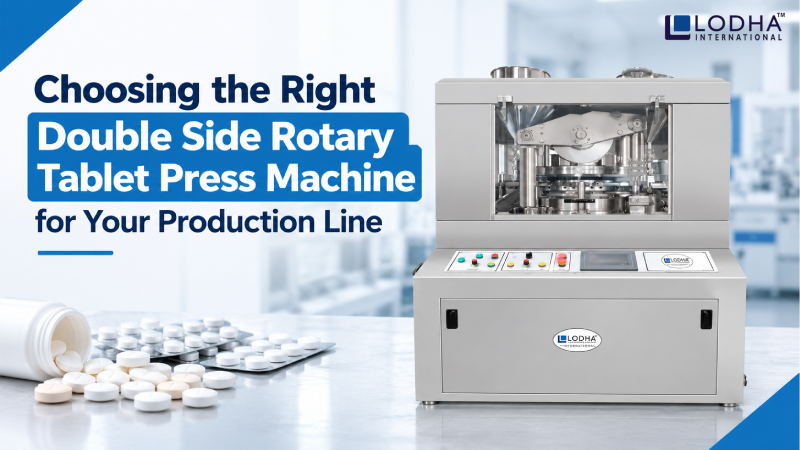
A double-sided rotary tablet press produces tablets from powder or granules through a continuous rotary compression mechanism.
The tableting process follows four main stages: filling, metering, compression and tablet ejection. Upper and lower punches compress the material inside the die to form the required tablet.
The machine is designed with an enclosed tableting area, stainless-steel exterior/contact construction and operator-safety features for production-scale tablet compression.
Available LI-DT Configurations
Choosing the right station configuration depends on tooling, tablet size, required pressure and production output.
Model | Stations | Tooling | Max. Operating Pressure | Max. Tablet Diameter | Listed Output/Hour |
LI-DT 37 | 37 | D | 10 Ton | 23 mm (25.4 mm on demand) | 87,000–222,000 |
LI-DT 45 | 45 | B | 6.5 Ton | 16 mm | 96,000–324,000 |
LI-DT 55 | 55 | BB | 6.5 Ton | 11 mm | 120,000–396,000 |
LI-DT 61 | 61 | BB | 6.5 Ton | 11 mm | 132,000–438,000 |
The LI-DT 37 provides higher maximum compression pressure and supports larger tablet diameters, while the 45, 55 and 61 station configurations provide progressively higher listed production ranges for suitable tablet formats.
As a Double Side Rotary Tablet Press Manufacturer in India, we recommend selecting the model according to the tablet and tooling requirement rather than station count alone.
Key Factors When Choosing the Right Model
1. Required Production Output
Production requirements are an important starting point. The listed output increases from the LI-DT 37 through the LI-DT 61, but actual model selection should also account for tooling and tablet dimensions.
2. Tablet Size
The LI-DT 37 supports tablets up to 23 mm in diameter, with 25.4 mm available on demand. The LI-DT 45 supports up to 16 mm, while the LI-DT 55 and LI-DT 61 are specified for tablets up to 11 mm.
3. Tooling Requirement
The machines use different tooling:
- LI-DT 37: D tooling
- LI-DT 45: B tooling
- LI-DT 55: BB tooling
- LI-DT 61: BB tooling
Tooling should therefore be considered early in the selection process.
4. Compression Pressure
The LI-DT 37 is rated for maximum operating pressure of 10 tons, while the LI-DT 45, 55 and 61 configurations are rated at 6.5 tons. The required compression force should match the formulation and tablet specification.
Machine Features for Production Operation
The Lodha Press II includes several features designed for tablet-production operation:
- Square GMP-oriented machine design
- Easy cleaning access
- Operator-friendly material feeding
- Digital tablet and RPM counter
- Effective dust-extraction nozzles
- Upper-punch penetration adjustment
- Guard interlocks
- One-shot lubrication system
- Double-sided lifting cams
- Anti-vibration mounts
- Overload pressure-release system
- Reverse-direction motion protection
- Turret speeds up to 40 RPM
These features support controlled operation, routine maintenance and operator safety.
Optional Features and Production Flexibility
Different production requirements may call for additional machine features.
Available options listed for the Lodha Press II include:
- Intermittent automatic lubrication pump
- Force-feeding attachment
- SS 316 middle plate in the turret
- Electroless nickel-plated turret
- Two-layer tablet compression capability
- AC variable drive for the main motor
- Front controls for setting operating parameters outside the machine
These options should be finalized according to the product and production requirement rather than assumed as standard on every configuration.
GMP-Oriented Construction and Safety
For pharmaceutical tablet production, machine construction, cleaning access and safety are important selection considerations.
The product page describes stainless-steel contact components and exterior construction for cGMP-oriented operation, along with an enclosed tableting area designed to reduce noise. Guard interlocks, overload protection, reverse-motion protection and anti-vibration mounts are also included in the machine’s listed features.
Client-approved advanced automation features such as IPC with SCADA System – 21 CFR Part 11 Compliance should only be specified when they are confirmed for the selected pharmaceutical machine configuration. They are not listed as a standard feature on this particular LI-DT 37/45/55/61 product page, so they should not be assumed here.
Double Side Rotary Press or Lab Mini Rotary Press?
Production scale is an important distinction.
The LI-DT 37, 45, 55 and 61 station machines are designed for production-scale tablet compression with substantially higher station counts and output.
For laboratory work, formulation development or smaller batches, Lodha also offers dedicated lab/mini rotary tablet presses. Buyers searching for a Lab Mini Rotary Tablet Press Manufacturer in India should therefore evaluate a lab-scale machine separately rather than selecting a production-scale double side press for an R&D requirement. Lodha’s lab rotary range is specifically positioned for small production batches and research applications.
Why Choose Lodha International LLP?
we focus on application-based tablet-press selection.
Our Double Side Rotary Tablet Press range offers 37, 45, 55 and 61 station configurations with different tooling, tablet-size capabilities and production outputs.
As a Double Side Rotary Tablet Press Machine Manufacturer in India, we work with customers to understand tablet size, tooling, compression pressure and required output before recommending a suitable configuration.
This approach helps ensure that machine selection is based on the actual formulation and production process rather than output figures alone.
Conclusion
Choosing the right double side rotary tablet press machine requires a careful comparison of station count, tooling, compression pressure, tablet diameter and required production capacity.
For production-scale tablet manufacturing, the LI-DT 37, LI-DT 45, LI-DT 55, and LI-DT 61 models are available in different configurations, while Lodha’s mini rotary tablet presses are intended for laboratory and R&D applications.
If you are looking for a Double Side Rotary Tablet Press Manufacturer in India, contact Lodha International LLP to discuss your tablet size, tooling, formulation and production requirements.
Phone: +91 74350 31331
Email: info@lodhapharma.com Lodha Pharma
Frequently Asked Questions
What factors should I consider when choosing a double side rotary tablet press machine?
When selecting a double side rotary tablet press machine, consider production output, tablet size, tooling requirements, and maximum compression pressure. Each of these factors influences the suitability of the machine for your specific production needs.
How does the LI-DT 37 model compare to other models from Lodha International?
The LI-DT 37 offers a maximum operating pressure of 10 tons and supports larger tablet diameters up to 23 mm, making it suitable for higher compression needs. In contrast, models LI-DT 45, 55, and 61 cater to progressively smaller tablet sizes and lower pressure requirements, focusing more on output efficiency.
What is the significance of tooling in a double side rotary tablet press?
Tooling is essential as it determines the shape, size, and compression of the tablets produced. Different models utilize distinct tooling types, and selecting the correct tooling early in the process ensures compatibility with your production specifications.
Why should I choose Lodha International as my double side rotary tablet press machine manufacturer in India?
Lodha International LLP focuses on application-based tablet press selection, ensuring that the right machine is recommended based on your specific tablet size, tooling, compression requirements, and production capacity. This personalized approach sets us apart as a reliable manufacturer.
Can I use a double side rotary tablet press machine for laboratory-scale applications?
While double side rotary tablet press machines like the LI-DT series are designed for production-scale use, Lodha also offers dedicated lab/mini rotary tablet presses. For research and development or smaller batches, these lab-scale machines are more appropriate.