

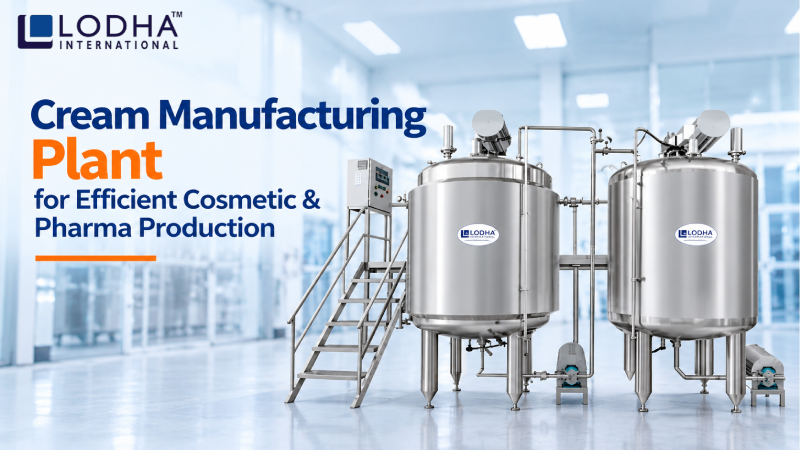
Key Takeaways
- Lodha International LLP offers efficient cream manufacturing plants for both cosmetic and pharmaceutical production in India.
- A cream manufacturing plant requires controlled mixing and homogenization for consistent semi-solid products.
- Key components include separate vessels for water and oil phases, ensuring optimal processing.
- Buyers should assess product viscosity, batch size, and homogenization needs before selecting a Cream Manufacturing Plant in India.
- Hygienic design is crucial for compliance with GMP standards in cosmetic and pharmaceutical manufacturing.
Lodha International LLP is a leading manufacturer of cream manufacturing plants for cosmetic and pharmaceutical production.
Creams, ointments, lotions and other semi-solid products require controlled mixing, homogenization and product transfer. For manufacturers planning a reliable Cream Manufacturing Plant in India, the right system should support consistent processing, hygienic handling and efficient movement of material from one production stage to the next.
What Is a Cream Manufacturing Plant?
A cream manufacturing plant is an integrated processing system used for preparing semi-solid formulations such as creams, ointments, lotions, emulsions and similar products.
The system typically combines vessels, agitators, homogenization equipment and transfer arrangements so that ingredients can be mixed, processed and transferred through a coordinated production setup.
At Lodha International LLP, our cream and ointment manufacturing solutions are designed for applications where manufacturers need controlled blending of water-phase and oil- or wax-phase ingredients before final homogenization.
How Does a Cream Manufacturing Plant Work?
The production process depends on the formulation, but the plant is generally built around preparation, mixing, homogenization and transfer.
- Water-phase preparation: Water-soluble ingredients are prepared in a dedicated vessel.
- Oil or wax-phase preparation: Oil-based or wax-based ingredients are heated and mixed separately where required.
- Transfer to the Main Manufacturing Vessel: The separately prepared phases are carefully introduced into the primary processing vessel for further manufacturing operations.
- Mixing and homogenization: Agitation and homogenization combine the phases to develop the required consistency and emulsion.
- Product transfer: The finished product is moved to a storage vessel or onward filling process through the connected transfer system.
The integrated system enables efficient and well-regulated processing while minimizing the need for repeated product handling across different stages.
Main Components of a Cream Manufacturing Plant
A complete system can include several processing and transfer components depending on the final project requirement.
Component | Main Function |
Water Phase Vessel | Prepares water-based ingredients |
Wax/Oil Phase Vessel | Handles oil- and wax-based ingredients |
Main Manufacturing Vessel | Performs final mixing and homogenization |
Storage Vessel | Holds the processed product before filling |
Vacuum Transfer System | Transfers material between suitable process stages |
CIP/Sanitization Arrangement | Supports cleaning and sanitization requirements |
Lodha’s cream manufacturing range also includes storage vessels with or without agitators, jacketed phase vessels, vacuum transfer arrangements and dedicated sanitization or skidded CIP systems were included in the selected configuration.
Why Homogenization Matters in Cream Production
Creams and lotions often contain ingredients that need to be dispersed into a smooth and uniform semi-solid mixture.
A homogenizer helps break down and distribute the formulation more evenly during processing. This is especially crucial in emulsion systems, where the aqueous and oil phases must be blended under carefully regulated mixing conditions.
The purpose of the plant is not simply to mix ingredients, but to create a controlled process for producing a uniform semi-solid formulation.
For B2B buyers evaluating a Cream Manufacturing Plant in India, the homogenization arrangement should be reviewed together with product viscosity, batch size and formulation requirements.
Mixing and Product-Handling Features
The exact configuration should always be selected according to the product and approved project scope.
Depending on the machine setup, relevant features can include:
- Agitated water- and oil-phase vessels
- Main manufacturing vessel with homogenization
- Teflon-supported scraping mechanism
- Variable-speed or step-less mixing control
- Vacuum-assisted transfer.
- Stainless-steel operating platform
- Control panel for process operation.
- CIP and sanitization arrangements
The cream production plant range is designed around an enclosed processing arrangement that supports product transfer from preparation vessels through to storage or filling stages.
Hygienic Design for Pharmaceutical and Cosmetic Production
For pharmaceutical and cosmetic processing, cleanable surfaces and suitable product-contact materials are important considerations.
Lodha’s current process-equipment information references SS316/SS316L contact parts, cleanable surfaces and GMP-oriented construction across applicable pharmaceutical processing systems. The specific material grade and degree of automation should be determined based on the requirements and configuration of the chosen plant setup.
For suitable pharmaceutical projects, the machine scope can be designed to support EU GMP and US FDA cGMP requirements, with the exact construction, controls and qualification documentation defined according to the approved requirement.
Applications of a Cream Manufacturing Plant
A well-configured cream plant can support several semi-solid and emulsion products.
Typical applications include:
- Pharmaceutical creams and ointments
- Cosmetic face and body creams
- Lotions
- Hair-care products
- Gels
- Emulsions
- Herbal and Ayurvedic semi-solid products
Lodha also positions its ointment and cream manufacturing systems for products such as skincare cosmetics, hair cosmetics, dressings, gels and other semi-solid formulations.
What Should Buyers Check Before Selection?
Before selecting a Cream Manufacturing Plant in India, buyers should define the actual process requirement rather than focusing only on vessel capacity.
- Product type and viscosity
- Required batch size
- Water-phase and oil-phase processing needs
- Heating and cooling requirements
- Homogenization requirement
- Vacuum transfer requirement
- Cleaning and sanitization method
- Product-contact material requirement
- Integration with storage and filling equipment
These factors help our team determine which vessels, agitators, transfer systems and control features are suitable for the final configuration.
Why Choose Us
At Lodha International LLP, we focus on application-based process solutions for pharmaceutical, cosmetic, herbal and related manufacturing requirements. Our cream manufacturing systems can combine phase-preparation vessels, mixing, homogenization, storage, transfer and cleaning arrangements within one coordinated production setup. As a Cream Manufacturing Plant in India manufacturer, we work with customers to understand the formulation, batch size, product viscosity, hygiene requirements and downstream process before finalizing the equipment configuration.
Conclusion
A cream manufacturing plant plays an important role in producing consistent creams, ointments, lotions and other semi-solid formulations. The right system should match the product formulation, batch size, homogenization requirement, transfer method and cleaning process.
Lodha International LLP provides cream and ointment manufacturing solutions for cosmetic, pharmaceutical and related applications. When selecting a Cream Manufacturing Plant in India, manufacturers should evaluate the complete process rather than choosing individual vessels in isolation. A properly configured plant can support efficient mixing, homogenization and product transfer across the production workflow.
Planning a new cream, ointment or lotion production setup? Contact Lodha International LLP to discuss your batch size, formulation, processing and automation requirements with our team.
Phone: +91-7435031331
Email: sales@lodhapharma.com
Frequently Asked Questions
What is a cream manufacturing plant?
A cream manufacturing plant is an integrated system designed for producing semi-solid formulations like creams, ointments, and lotions. It combines various components, such as vessels, agitators, and homogenizers, to mix ingredients and facilitate controlled processing.
How does a cream manufacturing plant work?
The cream manufacturing process typically involves multiple stages, including water-phase preparation, oil or wax-phase preparation, mixing, homogenization, and product transfer. Each phase is carefully controlled to ensure a consistent and efficient production workflow.
What should manufacturers check before selecting a Cream Manufacturing Plant in India?
Before selecting a cream manufacturing plant, manufacturers should assess their process requirements, including product type, viscosity, batch size, heating needs, homogenization requirements, and sanitization methods. This ensures the chosen plant is well suited to their specific production goals.
Why is homogenization important in cream production?
Homogenization is crucial in cream production as it ensures a smooth and uniform consistency in the final product. It aids in effectively blending the aqueous and oil phases, which is essential for stable emulsion systems.
What applications can a Cream Manufacturing Plant in India support?
A cream manufacturing plant can support a wide range of applications, including pharmaceutical creams, cosmetic lotions, herbal products, and gels. The versatility of these plants allows for the production of various semi-solid formulations tailored to specific industry needs.