

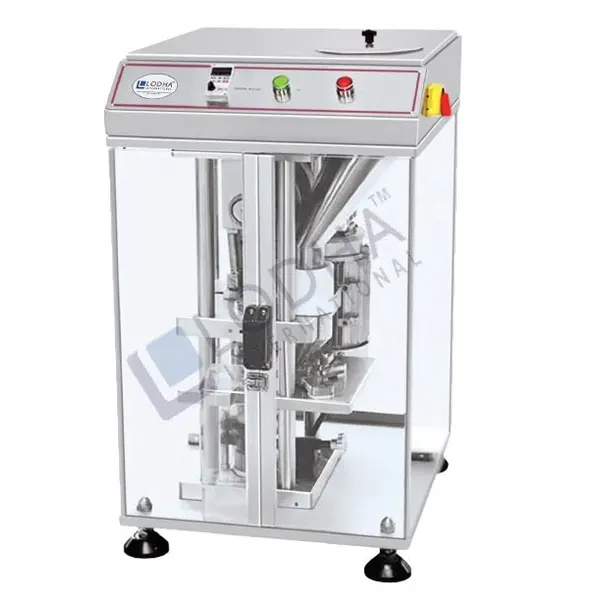
Manufacturer of R&D Pilot Lab Single Punch Tablet Press
Creating tablets that are consistent in size, shape, and weight is the function of a fundamental mechanical device known as a single-station tablet press. The machine produces tablets in relatively small batches for a variety of products, including cosmetics, drugs, and household cleaners. A single station table press is ideal for producing simple shaped tablets in smaller quantities, rather than utilizing larger industrial machines. Consequently, it is perfect for research and development teams that require the creation of new materials in limited quantities, compounding pharmacists who must evaluate new formulations, and providers of nutraceuticals, supplements, and herbal remedies seeking an economical approach to producing smaller quantities of products. This tablet press is widely used in various environments due to its affordability and versatility. In the petrochemical sector, for example, industrial catalysts are produced utilizing single station tablet presses.
Optional Features
To create tablets, powders are pressed into a single die using a punch or stamp. The composition of the powder is completely influenced by its intended application. In the pharmaceutical sector, for example, the powder comprises various components, including the active pharmaceutical ingredient, several inert excipients, lubricants, disintegrators, and more. The device can operate either manually or with power assistance. In the first case, each tablet needs to be produced one at a time; in the second case, production can occur in smaller batches, typically at a speed of 5000 tablets per hour. Here are several typical components of a single station press:
- The compacted grains are stored in a hopper. Gravity pulls the powdered stuff down from the hopper and into the die.
- The die is the mould used to form the desired shape from the compressed material. The lower punch creates the die’s structure, while the upper punch lands on the powder from above to compact it.
- There are upper and lower punches, with the former providing the necessary compressive power to bind the powder granules together into a tablet. The tablet is ejected from the die when the compression phase is complete, when the bottom punch is raised from its base.
- Mechanically guiding the motions of the two blows is a cam track.
- A device that controls the amount of loose powder in a die by varying the depth of the lower punch is called a capacity regulator.
- The ejection regulator makes sure that the lower punch is flush with the surface of the die when it is raised at the end of compression, allowing the finished tablet to be swept away and into the collecting vessel.
- The upper and lower punches, along with the hopper shoe, are moved by means of a driving wheel.
Remember that there is only one upper and lower punch along with a die set utilized in a tablet machine featuring a single station. The upper punch is solely responsible for compressing the tablet, while the lower punch stays stationary during the entire procedure. The powder material was crushed through the application of pressure using the upper and lower punches. The shape of a tablet is defined by the cavity of the die.
- Filling: In the first stage, the upper punch is retracted from the die by a cam, and the lower punch is positioned low within the die cavity to receive powder as it descends from the hopper.In the second step, the bottom punch is set to the desired amount of material and, as it is lifted, any surplus powder is blown out of the die
- Compression: To compress the powder into a tablet at Stage 3, the bottom punch stays put while the top punch descends into the die.
- Ejection: At the last stage, the upper punch is retracted while the lower punch pulls upward, releasing the tablet from the die. The surface plate then scrapes the tablet off the die.
The specifications of each tablet, including its composition, compression, and capacity, are encoded within the machine. Operating the machine manually is the typical approach for making adjustments and assessing the appearance, dimensions, and mechanical strength of the produced tablets. The mechanical adjustments are secured, and the machine is ready for automated production once the operator is satisfied with the tablet’s quality. When tablets are manufactured in significant volumes, it is crucial to regularly assess the settings to guarantee that the quality and standards of the final product remain intact.
Connect With Us
Location We Serve
Andhra Pradesh | Arunachal Pradesh | Assam | Bihar | Chhattisgarh | Goa | Gujarat | Haryana | Himachal Pradesh | Jharkhand | Karnataka | Kerala | Madhya Pradesh | Maharashtra | Manipur | Meghalaya | Mizoram | Nagaland | Odisha (Orissa) | Punjab | Rajasthan | Sikkim | Tamil Nadu | Telangana | Tripura | Uttar Pradesh | Uttarakhand | West Bengal
Agra | Ahmedabad | Aligarh | Allahabad | Amritsar | Amroha | Bengaluru | Bhopal | Chandigarh | Chennai | Coimbatore | Delhi | Dhanbad | Faridabad | Firozabad | Gurgaon | Guwahati | Gwalior | Hubli-Dharwad | Hyderabad | Indore | Jabalpur | Jaipur | Jodhpur | Kalyan-Dombivali | Kanpur | Kolkata | Lucknow | Ludhiana | Madurai | Meerut | Moradabad | Mumbai | Nagpur | Nashik | Patiala | Patna | Pune | Raipur | Rajkot | Siliguri | Solapur | Srinagar | Surat | Thane | Vadodara | Varanasi | Vasai-Virar | Vijayawada | Vishakhapatnam