

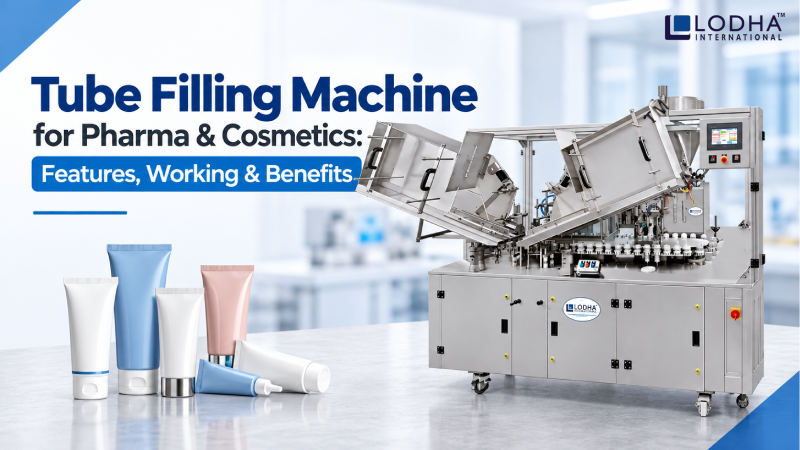
Key Takeaways
- Understand the features of tube filling machines for pharmaceutical and cosmetic applications, enhancing efficiency and consistency.
- Learn about different tube filling machine configurations including double head, single head, rotary, and semi-automatic systems.
- Discover key benefits such as reduced manual handling, controlled sealing, and increased production continuity.
- Explore why Lodha International LLP is a leading Double Head Linear Tube Filling Machine Manufacturer in India, offering tailored solutions.
- Find out how tube filling machines support various products, from creams to herbal formulations, ensuring quality and safety.
Creams, ointments, gels, pastes and similar semi-solid products require controlled filling and reliable tube sealing to maintain consistent packaging.
At Lodha International LLP, we manufacture tube filling solutions for pharmaceutical, cosmetic and other viscous-product applications. Our range includes linear, rotary and semi-automatic configurations for plastic, laminate and aluminium tubes. The right machine depends on the product, tube material, filling quantity, production output and required level of automation.
What Is a Tube Filling Machine?
A tube filling machine is designed to dose products such as creams, ointments, gels and pastes into suitable tubes and complete downstream operations such as sealing, coding, trimming and ejection according to the machine configuration.
Lodha’s Double Head Linear Tube Filling Machine supports aluminium, laminate and plastic tubes. Its automated process can include tube feeding, orientation, filling, sealing, crimping, coding and final tube ejection.
For pharmaceutical and cosmetic manufacturers, machine selection should consider both the product characteristics and the tube format rather than production speed alone.
Tube Filling Machine Configurations
Lodha offers different tube-filling arrangements for different production requirements.
Double Head Linear Tube Filling Machine
For manufacturers requiring higher output, the Double Head Linear Tube Filling Machine Manufacturer in India solution is designed around a two-head linear filling arrangement.
The LI-TF 120 configuration offers filling from 5 g to 200 g, output up to 120 tubes per minute, SS316 contact parts and ±1% stated filling accuracy. It also incorporates automatic tube feeding, orientation, filling, sealing, coding and tube ejection.
Single Head Linear Tube Filling Machine
A Single Head Linear Tube Filling Machine Manufacturer in India configuration is suitable where a single filling head meets the required production workflow.
Lodha’s LI-TF 60 supports a filling range of 5 g to 200 g and output up to 60 tubes per minute. Its listed features include PLC control, colour touchscreen, variable-speed control and automated tube loading, washing, positioning, filling, sealing and ejection.
Automatic Rotary Tube Filling Machine
A Rotary Tube Filling Machine Manufacturer in India offers a rotary approach in which tubes move through different processing stations.
Lodha’s LI-TUBO 12S is a 12-station system with output up to 50 tubes per minute and a filling range up to 250 g, depending on the product and configuration. It includes No Tube–No Fill, pneumatic sealing/coding/cutting and automatic tube ejection.
Semi-Automatic Rotary Tube Filling Machine
For applications that allow greater operator involvement, a Semi Automatic Rotary Tube Filling Machine Manufacturer in India can provide a more operator-assisted setup.
Lodha’s LI-STF 8 uses a single filling head and eight stations, with output of approximately 25–30 tubes per minute. Tube loading and orientation are manual, while filling, sealing and ejection functions support a controlled packaging process.
How Does a Tube Filling Machine Work?
Although the sequence varies by model, an automatic tube-filling process generally includes:
- Tube Feeding: Empty tubes are manually or automatically introduced into the machine.
- Tube Orientation: A photocell or registration system aligns the tube according to the print mark where provided.
- Product Filling: The dosing system fills the required quantity of cream, ointment, gel or paste.
- Tube Sealing: Plastic and laminate tubes may use hot-air sealing, while suitable aluminium tubes can be crimped according to the machine configuration.
- Coding and Trimming: Batch information can be applied and excess tube material trimmed where applicable.
- Tube Ejection: The finished tube is automatically discharged for further packing.
The double-head linear system also incorporates a No Tube–No Fill device so filling is prevented when a tube is not correctly present at the filling station.
Automation, Safety and Filling-Control Features
Tube filling equipment can incorporate several controls to improve repeatability, container handling and operator safety.
Depending on the selected configuration, relevant Lodha features include:
- No Tube–No Fill sensing
- Automatic tube loading on applicable linear models
- Photoelectric print registration
- Variable-speed operation
- Fine filling-volume adjustment
- Automatic tube orientation
- Sealing, coding and trimming stations
- Automatic tube ejection
- Emergency stop and reset functions
- Machine interlocks and indications
- Protective guarding around moving parts
- Production counter on applicable configurations
The LI-TF 120 also uses an overload clutch and micro-switch cut-off arrangement for machine protection.
GMP-Oriented Design for Pharma & Cosmetics
For pharmaceutical and cosmetic applications, hygienic construction and accessible cleaning are important.
The double-head linear machine is presented with GMP-oriented design and SS316 product-contact components. Its standard specification also includes safety guarding, a stainless-steel pump arrangement and removable change parts for suitable tube sizes.
For applicable pharmaceutical projects, machine configurations can be designed to support EU GMP and US FDA cGMP requirements, depending on the selected controls, intended application and approved scope of supply.
Advanced pharmaceutical automation such as PLC/HMI, IPC with SCADA or 21 CFR Part 11 functionality should be specified only on machine configurations where those controls are actually included.
Applications in Pharmaceutical and Cosmetic Production
Tube filling machines are widely used for semi-solid products such as:
- Pharmaceutical creams
- Ointments and topical formulations
- Cosmetic creams and gels
- Toothpaste and personal-care products
- Herbal and Ayurvedic formulations
- Balms and pastes
- Suitable food products
- Other viscous formulations
The double-head linear machine is positioned by Lodha for pharmaceutical, cosmetic, food, dairy and other suitable industrial applications.
Key Benefits of Tube Filling Machines
A properly configured tube filling machine can support:
- Consistent volumetric filling
- Reduced manual product handling
- Controlled sealing and coding
- Higher production continuity
- Cleaner filling through controlled nozzles
- Faster handling through automatic feeding and ejection
- Flexibility for aluminium, laminate and plastic tubes
- Safer machine operation through guarding and interlocks
- Easier integration of filling, sealing, coding and ejection into one process
The actual benefits depend on the machine selected and the characteristics of the product and tube.
Why Choose Lodha International LLP?
At Lodha International LLP, we focus on matching tube filling equipment with the actual product, tube and production process.
Our range covers double-head and single-head linear systems as well as automatic and semi-automatic rotary tube fillers. Depending on the selected machine, solutions can combine automatic feeding, orientation, volumetric filling, sealing, coding, trimming and tube ejection.
For pharmaceutical and cosmetic manufacturers, we also consider hygienic construction, safety, changeover requirements and suitable automation when finalizing the machine configuration.
Conclusion
Choosing the right tube filling machine requires careful consideration of product viscosity, tube material, fill range, sealing method, output and automation needs.
Whether the requirement is for a double-head linear system, single-head linear machine, automatic rotary filler or semi-automatic rotary configuration, the machine should be selected around the actual production process.
For tube filling solutions for pharmaceutical and cosmetic products, contact Lodha International LLP to discuss your product, tube type, filling range and production requirements.
Phone: +91 74350 31331
Email: info@lodhapharma.com
Frequently Asked Questions
What is a tube filling machine used for?
A tube filling machine is designed to fill creams, ointments, gels, and pastes into tubes, ensuring consistent packaging through processes like filling, sealing, coding, and ejection. It streamlines the production workflow, making it essential for pharmaceutical and cosmetic manufacturers.
What are the benefits of using a double head linear tube filling machine?
The double head linear tube filling machine offers higher output rates, filling up to 120 tubes per minute with a high degree of accuracy. It supports various tube materials and provides an automated process for tube feeding, orientation, filling, sealing, and ejection, enhancing productivity.
How does a rotary tube filling machine differ from a linear tube filling machine?
Rotary tube filling machines operate in a circular manner, allowing tubes to pass through sequential processing stations, which can be more efficient for certain applications. In contrast, linear tube filling machines fill tubes in a straight line, which may be better suited for lower-output requirements.
Why choose Lodha International LLP for tube filling machines?
Lodha International LLP specializes in a range of tube filling machines, including automatic and semi-automatic systems. They focus on matching equipment to product and production needs, ensuring hygienic construction and safety, which is crucial for both pharmaceutical and cosmetic applications.
What should manufacturers consider when selecting a tube filling machine?
Manufacturers should consider the product viscosity, tube material, required fill range, sealing methods, production output, and level of automation needed. This ensures the selected machine effectively meets the unique requirements of the production process.